




IMF admits Greece bailout mistakes

Washington - UPI
The International Monetary Fund admitted it didn't realize how damaging the draconian Greek bailout austerity measures it imposed would be to Greece's economy. The 2010-imposed austerity measures in the first bailout helped Greece avoid bankruptcy but also caused the country's economy, already in recession, to plummet, the IMF said in an internal report made public after its contents were reported by The Wall Street Journal. In contrast to publicly stated high hopes of the first bailout of $144 billion put together by the "troika" of the IMF, European Commission and European Central Bank in May 2010, "market confidence was not restored, the banking system lost 30 percent of its deposits and the economy encountered a much deeper-than-expected recession with exceptionally high unemployment," the report said. This not only undermined Greece's already debilitated economy but also ruined the country's chances of paying back its debt anywhere near on time or in full, the report said, pointing out IMF-projected fiscal targets for Greece were unrealistically "ambitious." "The fiscal targets became even more ambitious once the downturn exceeded expectations," the report said, adding Greece should not have qualified for further bailouts due to doubts about the sustainability of its debt. But the report said the rescue -- which bent the IMF's own lending rules -- kept Greece in the 17-nation eurozone, limited the possibility of spreading Greek blight to healthy economies and ended up costing the troika less than creating terms that would have actually let Greece get through the debt crisis in a sustainable way, without such a severe recession. "While earlier adjustment of the targets could have tempered the contraction, the program would have then required additional financing," which neither the IMF nor eurozone governments were prepared to give, the document said. Senior IMF figures, including Managing Director Christine Lagarde, have repeatedly said since 2010 Greece's debt level was "sustainable," which means it's likely to be repaid in full and on time. Lagarde acknowledged to the Journal in a separate interview last week the IMF skirted its own rules, despite privately having considerable misgivings about Greece's debt sustainability. In Athens, officials said the report confirmed the bailout price exacted on Greece was too great for a country beset by massive debts, pernicious tax evasion and a large underground economy. "For too long [troika officials] refused to accept that the program was simply off-target by hiding behind our failure to implement structural reforms," one Greek official told British newspaper The Guardian, referring to painful structural reforms required by the troika to make Greece's economy more competitive. "Now that reforms are being applied, they've had to accept the bitter truth," the official said.



GMT 09:54 2018 Tuesday ,23 January
Davos-bound bosses very upbeat on world economyGMT 09:37 2018 Tuesday ,23 January
Former KPMG executives charged in accounting oversight scamGMT 22:49 2018 Sunday ,21 January
Brexit special trade agreement possibleGMT 22:46 2018 Saturday ,20 January
China economy rebounds in 2017 with 6.9% growthGMT 22:37 2018 Saturday ,20 January
GE takes one-off hit of $6.2 bn linked to insurance activitiesGMT 19:58 2018 Saturday ,20 January
Watchmakers hope to make Chinese market tickGMT 19:54 2018 Saturday ,20 January
US shutdown unlikely to harm debt rating: FitchGMT 19:50 2018 Saturday ,20 January
EU's Moscovici slams Ireland, Netherlands as tax 'black holes'



With Job Cuts, China Deal
France's Carrefour revamps operations
Paris - Emiratesvoice
France's Carrefour group said Tuesday it is overhauling its business in a transformation plan involving thousands of job cuts, a product revamp and new partnerships in China. Carrefour, which was the world'sTo partake in Beiteddine Festivals
Singer Bruni arrives in Beirut Sunday evening
Beirut - NNA
French renowned singer and supermodel, Carla Bruni, is expected to arrive this evening at Rafic Hariri International Airport in Beirut, accompanied by her husband, former French President Nicolas Sarkozy. BruniIn France
Microsoft to open 4 data centres
Paris - Emiratesvoice
Microsoft is to open 4 data storage centers in France to meet strong customer demand for cloud computing, the head of the software giant's French operations told the Agence France-Presse onIn Olympic Spotlight
'Friendly and kind' N. Korean skaters
Taipei - Emiratesvoice
North Korea's figure skaters Ryom Tai-Ok and Kim Ju-Sik are "friendly and kind and a little bit shy", South Korea's Kim Kyueun said Tuesday ahead of their hugely anticipated Olympic appearance. The skater is competing with her partner Alex Kam in theFor $11.6 Bn
Sanofi buys US haemophilia treatment
Paris - Emiratesvoice
French pharmaceutical firm Sanofi said Monday it had reached an agreement to purchase US biotech company Bioverativ, which specialises in treatments for haemophilia and rare blood disorders, for $11.6 billion. Sanofi's chief executive Olivier Brandicourt said the acquisition "enhances its presence in specialtyParis show pays homage
to 'eternal style' of late Alaia
Paris - Emiratesvoice
Two months after legendary designer Azzedine Alaia's sudden death plunged the fashion world into mourning, an exhibition in homage to the "King of Cling" opens Monday in his studios in Paris. The Tunisian-born designer, renowned for the way his clothes hugged the body, died suddenly in November aged 82, reportedly of heart failure after falling down the stairs at his home. The diminutive maverick, who ignored fashion week convention by showing when and where he wanted, in July produced his first couture collection in six years to rapturous reviews. Now some of his most iconic dresses are going on display in the glass-roofed gallery next to his studio and home in the Marais district where he used to show his creations. It includes the dress worn by supermodel Naomi Campbell, his longtime friend and muse, when she led
GMT 10:21 2016 Wednesday ,23 March
cartoon eleven
GMT 10:31 2014 Tuesday ,23 December
Mirages of failure: Lebanon cannot wait
GMT 12:07 2018 Tuesday ,23 January
Syria Kurds urge civilians to take up arms against Turk assault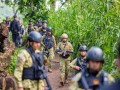
GMT 05:09 2024 Tuesday ,06 February
The Saudi-led Arab Coalition Forces have targeted a meeting of Houthi commanders in Beit Al Faqih, Hodeidah, killing scores of the
GMT 10:18 2018 Thursday ,30 August
Iran incapable of closing Hormuz, Bab Al Mandeb
GMT 04:52 2018 Saturday ,20 January
Confident Nadal demolishes Dzumhur
GMT 10:18 2018 Monday ,08 January
Eight children among 21 killed in Syria Idlib strikes: monitor
GMT 08:11 2017 Saturday ,11 March
Wenger under siege as Lincoln chase FA Cup's greatest shock
GMT 07:53 2018 Monday ,15 January
Balcony of Indonesia's stock exchange collapses
GMT 23:12 2016 Wednesday ,04 May
China's Tsinghua University listed 18 in THE World University Rankings
GMT 23:13 2017 Thursday ,30 November
January21st-February19th
GMT 08:35 2016 Tuesday ,24 May
Kicks out Swiss bank linked to Malaysia's 1MDB
GMT 10:33 2017 Saturday ,14 October
Landmark EU-Cuba deal to take effect
GMT 21:25 2017 Sunday ,28 May
There's no stopping gold's glitter
GMT 11:28 2017 Tuesday ,31 October
Eurozone third-quarter growth hits 0.6%: Eurostat
GMT 09:17 2017 Sunday ,29 October
British kayak adventurer slain in Brazil's Amazon
GMT 13:35 2016 Sunday ,25 December
Turkey-backed fighters kill 68 Daesh ultras near Al-Bab
GMT 23:50 2017 Sunday ,19 March
Palestinians give award to UN official who condemned Israel


Maintained and developed by Arabs Today Group SAL.
All rights reserved to Arab Today Media Group 2025 ©
Maintained and developed by Arabs Today Group SAL.
All rights reserved to Arab Today Media Group 2025 ©


Send your comments
Your comment as a visitor